
Used Car Valuation When the Price Guides Fail: 5 Real Cases
The cars your book can't price
Five real vehicles where the guides give up, and what a MarketCheck Valuation Report says instead
Every number below comes from real Vehicle Valuation Report runs in the Sandy, UT market (ZIP 84070). All figures are advertised (listed) prices; recently sold vehicles are shown at their last list price, the closest observable proxy to a transaction. The report links are live if you want to check our work.
Pricing a three-year-old RAV4 is not hard. Any book gets you within a thousand dollars, any manager with a decade on the desk gets closer, and everyone goes to lunch.
The problem is that nobody calls an appraiser about a three-year-old RAV4. The calls that matter are the weird ones. The Camry with 158,000 miles on a 2021 plate. The G-Wagon that costs more used than new. The Tesla trade where the book is six months stale and six months is a lifetime. Price those wrong and the mistake has a comma in it.
So we ran the weird ones. Six real cars, all listed for sale in one Utah market right now, through the Vehicle Valuation Report ($1.99 a run, through Claude or ChatGPT or the web). Here is what came back.
First, the easy one, so you can see how the report thinks
The 2021 RAV4 XSE. 52,900 miles, asking $38,039 at a local dealer.
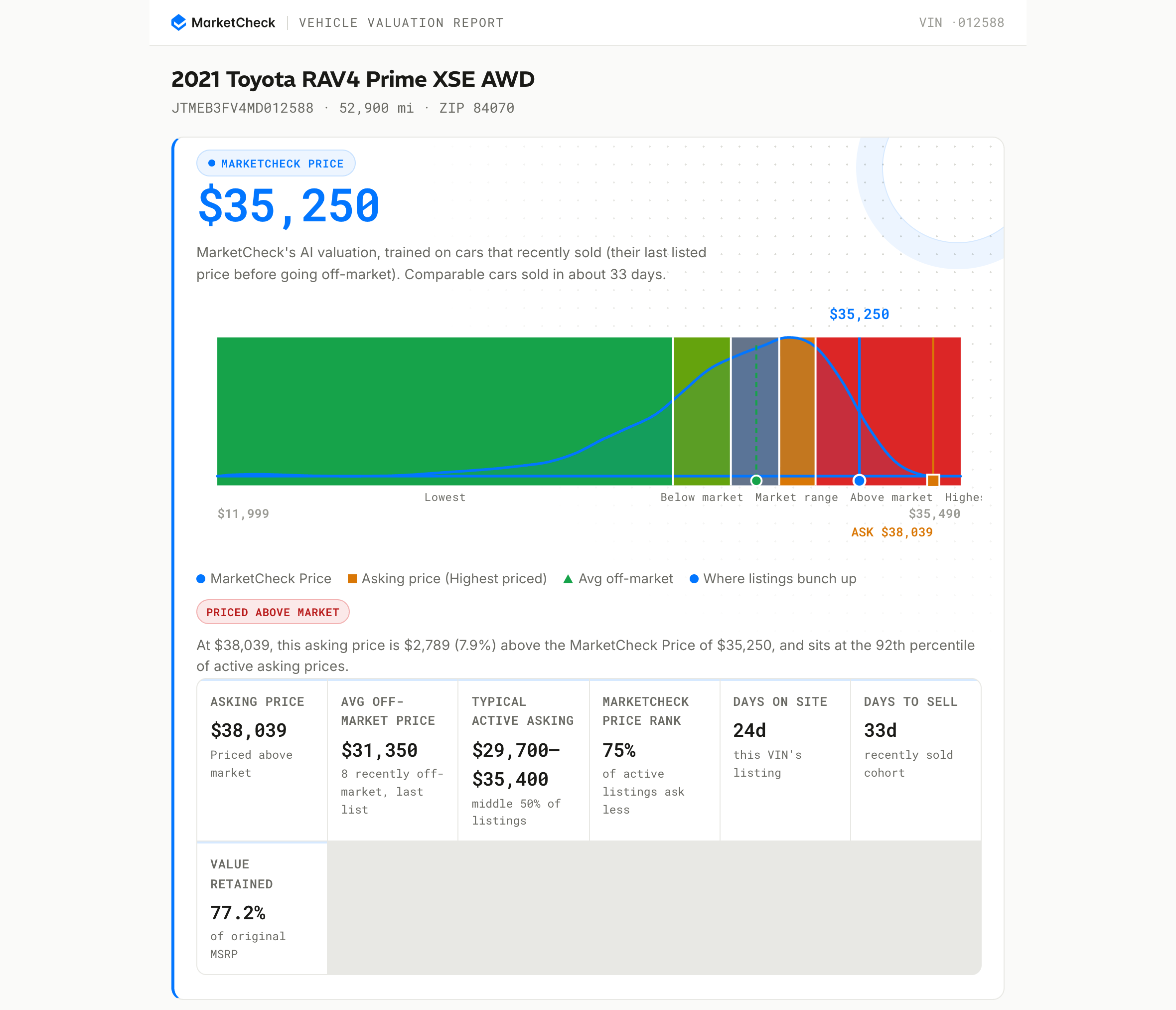
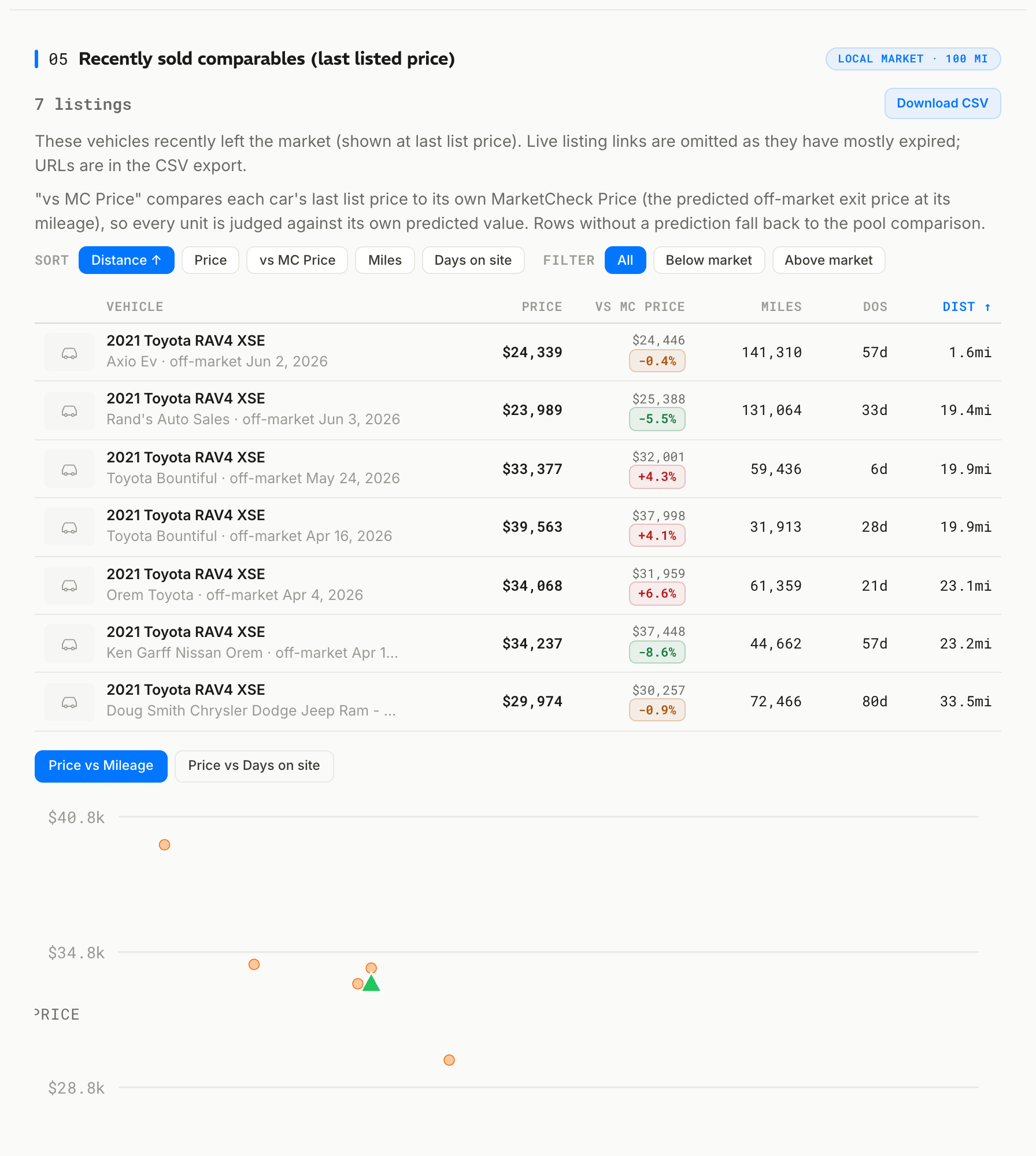
The report says $35,250, with high confidence, and shows its work: 273 comparables analyzed, a fair-value cross-check at $33,400 from recently sold cars, and a defensible range of $27,150 to $34,150 built on 7 off-market comps. It also grades the asking price for you: $38,039 is about 8% over the number, which on this lot is a choice, not an accident.
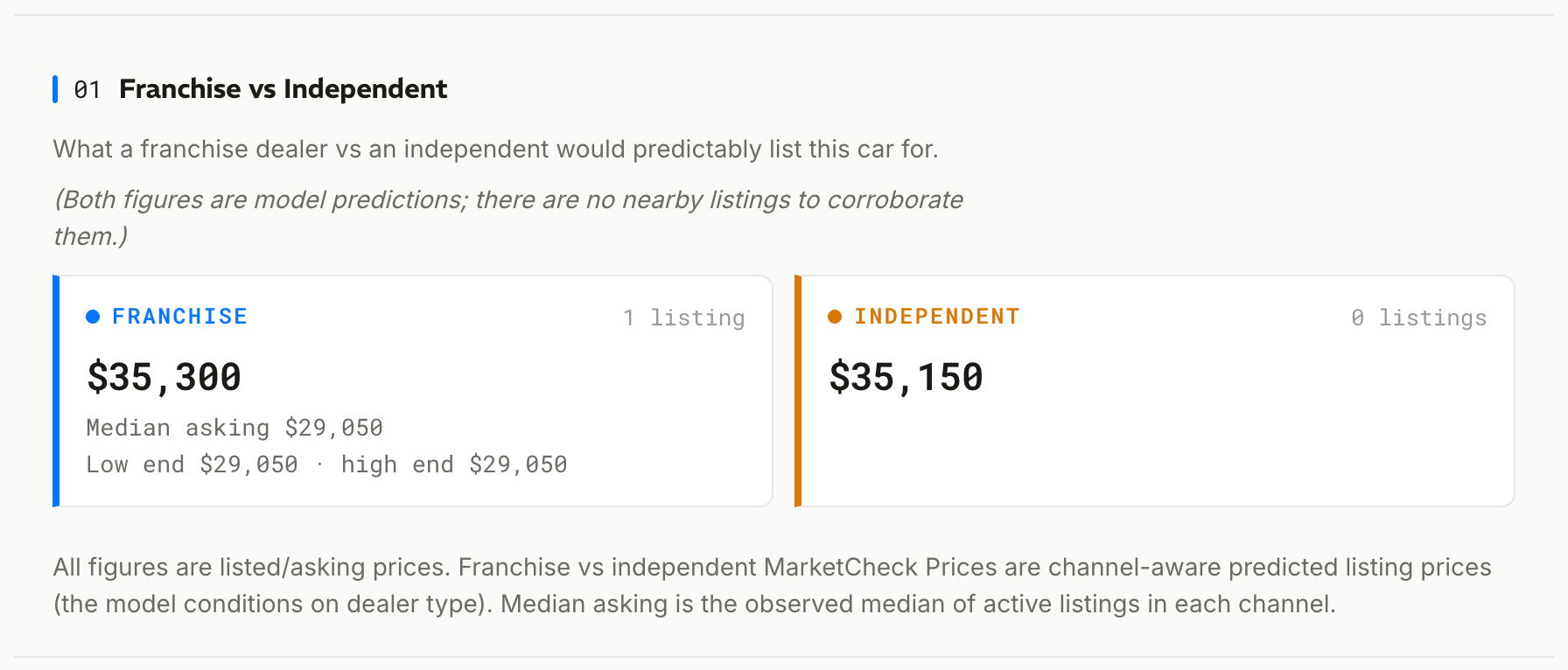
Two details worth noticing before the hard cases. The anchor is recently off-market comps, cars that actually left the market in the last 90 days at their last listed price. Not asking prices, which are wishes, and not stale transaction data, which is history. And every claim comes with the evidence attached:
Now the fun ones.
Case 1: the odometer that breaks the curve
2021 Toyota Camry XSE. 158,555 miles. Four model years old with fifteen years of driving on it.
Books handle mileage with adjustment curves, and adjustment curves are calibrated for normal cars. This is not a normal car. Meanwhile, if you just pull comps, you get lied to in the other direction: nearly every other 2021 Camry for sale has a third of the miles.
The report shows the whole tension instead of hiding it. The comp cross-check says $24,000, because the comp pool is full of 60,000-mile cars. The MarketCheck Price, which conditions on this VIN's actual odometer, says $20,200. And the dealer's ask? $17,500. They priced it below both numbers, likely off a book that panicked at the mileage.
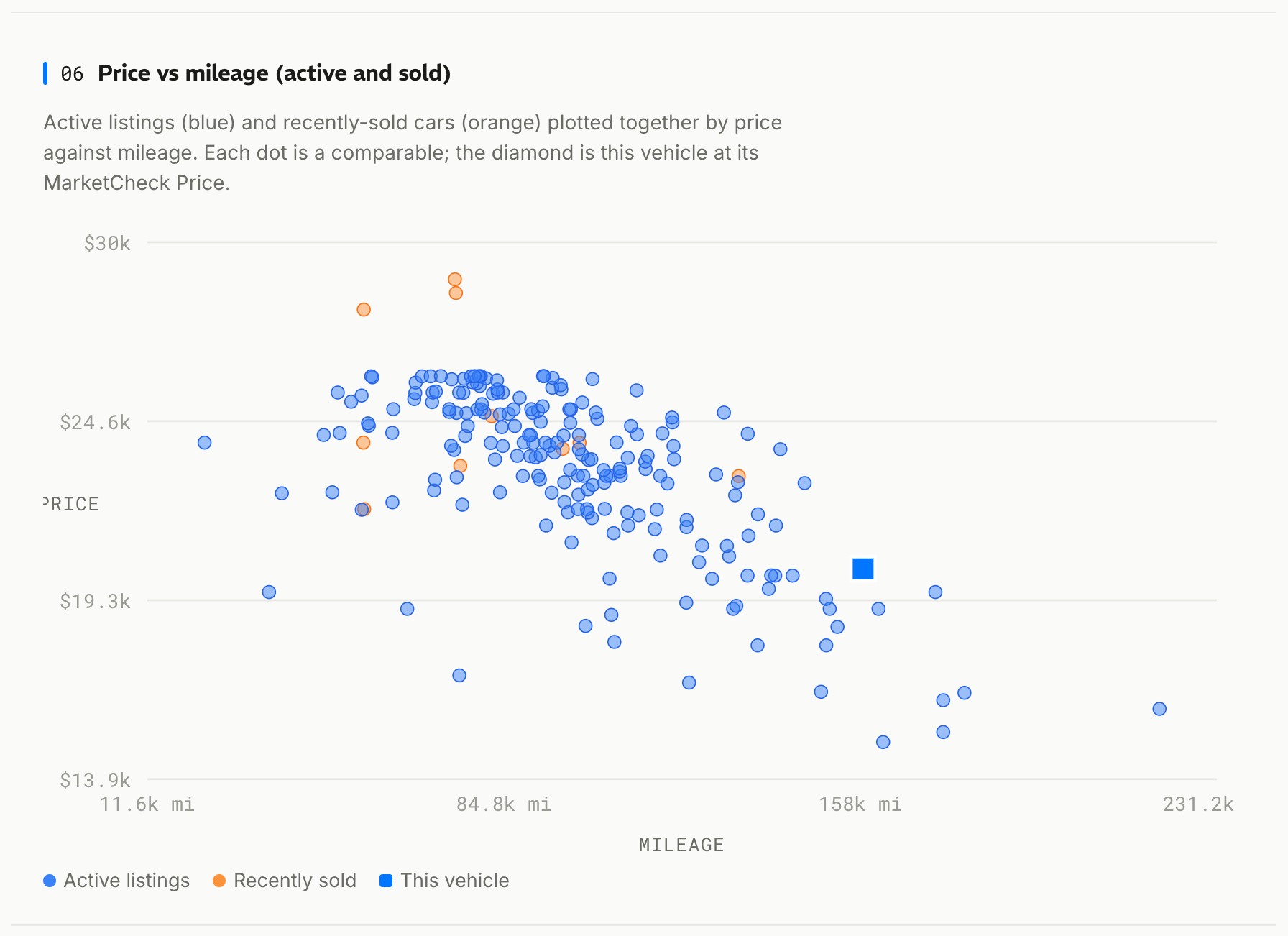
The takeaway: on mileage outliers the model and the raw comps will disagree, and both are telling you something. The report shows both. A seller here is leaving about $2,700 on the hood; a buyer just found the best deal on the lot.
Case 2: the car that costs more used than new
2025 Mercedes-AMG G-Class. 20 miles. Asking $229,345.
Every depreciation model ever built assumes a car loses value when it drives off the lot. The G-Wagon did not read the model. The report values it at $222,700, which is 116.7% of its original MSRP, and it is not confused about this: with no meaningful off-market history for a car this new and this rare, it anchors on the 225 active comparables instead and says so plainly.
The takeaway: the danger with allocation cars is a well-meaning manager "correcting" the price down to book. The premium is real, it is measurable, and here it comes with 225 receipts. This is the report you show the owner when they ask why the trade allowance looks like a mistake.
Case 3: the depreciation headline with a VIN attached
2024 Tesla Model 3, 21,079 miles. Asking $48,990.
The report says $35,050, with a range of $31,200 to $34,200 built on 12 recently sold comps. That ask is nearly 40% over the market. Not 4%. Forty.
Used EV values have moved faster than any print cycle can follow: new-car price cuts reset the used ladder underneath them, and a book that is even a quarter old prices a different market. The report's comps are from the last 90 days, so they have already absorbed whatever the headline did.
The takeaway: never take an EV trade against a book number. The gap between a stale guide and a 90-day comp window on this one car is five figures, and it lands on whoever prices last.
Case 4: the seventeen-year-old car with one year of miles
2008 Corvette Z06 with 11,794 miles. Asking $58,488.
Books are hopeless here twice over. Their mileage curve expects a 2008 to carry 200,000 miles, and their depreciation curve has no idea the car crossed over from used car to collector piece somewhere around 2015. The report values it at $59,000 against a comp cross-check of $50,000, on a thin, honest pool of 31 active comparables, and it tells you the pool is thin instead of pretending otherwise.
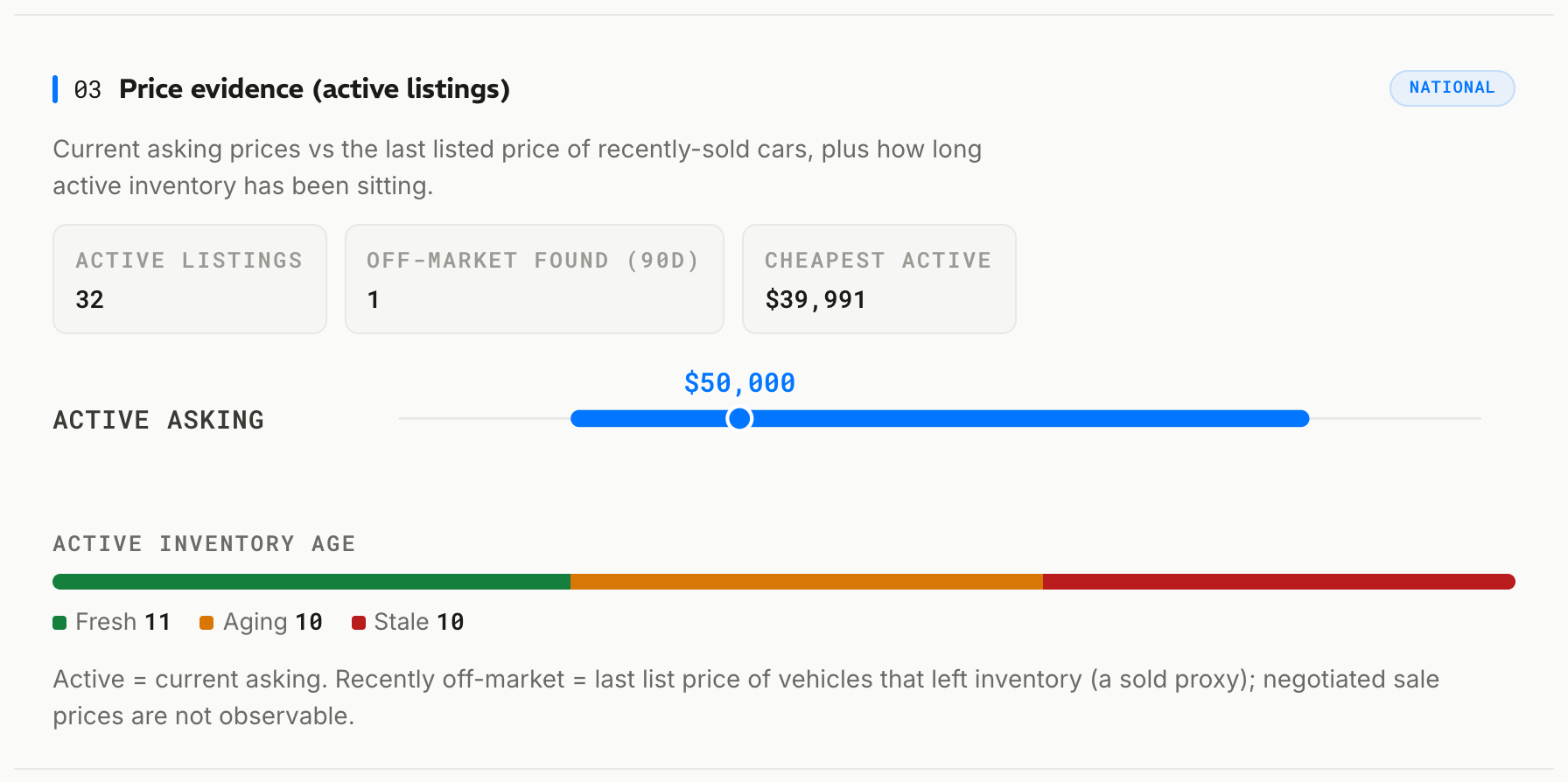
The takeaway: on collector metal, the spread between the model and the comps IS the appraisal. That $9,000 gap is where condition, history, and story live, and that judgment is worth more when it starts from documented evidence instead of a shrug.
Case 5: the truck whose market disagrees with itself
2026 Ford F-350 Platinum diesel, 21,127 miles. Asking $91,995.
Heavy-duty diesels are the most regional vehicles in America. The same truck is a commodity in Florida and a unicorn in a Utah mountain town. Here the model says $88,000 while the comp cross-check, built on a remarkable 278 off-market comps, says $100,350. The ask sits between them.
A book gives you one national number and false confidence. The report gives you both anchors and the reason they differ: spec-heavy trucks trade on configuration, and this market has been paying up for them.
The takeaway: when the two anchors disagree by five figures, that is not noise, that is information about your region. Price into the gap deliberately instead of discovering it at the auction lane.
And one honest failure
We also tried a 1993 Ferrari 512TR. The report refused: VINs from before 1996 predate the standard the decoder relies on, so rather than guess at a $400,000 car, it returns "could not decode" and charges you nothing.
We would rather the tool say "I don't know" on a Ferrari than be confidently wrong about it. Books do not extend that courtesy.
What this adds up to
- The anchor matters more than the algorithm. Recently off-market comps at last list price beat both asking-price wishes and stale transaction files, and the report tells you which anchor it used on every car.
- Two numbers beat one. The model and the comp cross-check agree on easy cars and split on hard ones, and the split is exactly where an appraiser or used-car manager earns their pay.
- Evidence attached, always. Every valuation ships with the comparables, the price-vs-mileage plot, the listing history, and a CSV of it all. It is an argument you can forward, not a number you have to defend.
- Speed changes what is possible. $1.99 and about half a minute per VIN means you can run the whole trade walk, not just the scary ones.
For appraisers specifically: the same report carries a certification block with your name, license, client, and an auto-numbered file series, itemized adjustments over the market-derived base, and the ability to exclude specific comps and re-derive, so the deliverable reads like your work product because it is.
Try it on your weird one
Everyone has one on the lot right now: the car nobody wants to put a number on. Connect MarketCheck AI Desk to Claude or ChatGPT and ask: "What is this worth? VIN, miles, ZIP." $1.99, high-confidence or honestly-labeled otherwise, evidence attached.
The six reports above, unedited: RAV4 · AMG G-Class · Camry 158k · Model 3 · Corvette Z06 · F-350